OpenCLIP
Welcome to OpenCLIP, an open-source implementation of OpenAI’s CLIP (Contrastive Language-Image Pre-training). This codebase provides production-ready models for zero-shot image classification, image-text retrieval, and transfer learning tasks.OpenCLIP is actively maintained by researchers at UW, Google, Stanford, Amazon, Columbia, and Berkeley, with continuous contributions from the open-source community.
What is CLIP?
CLIP learns visual concepts from natural language supervision by training on image-text pairs. This approach enables powerful zero-shot transfer capabilities, allowing models to classify images into categories they’ve never explicitly seen during training.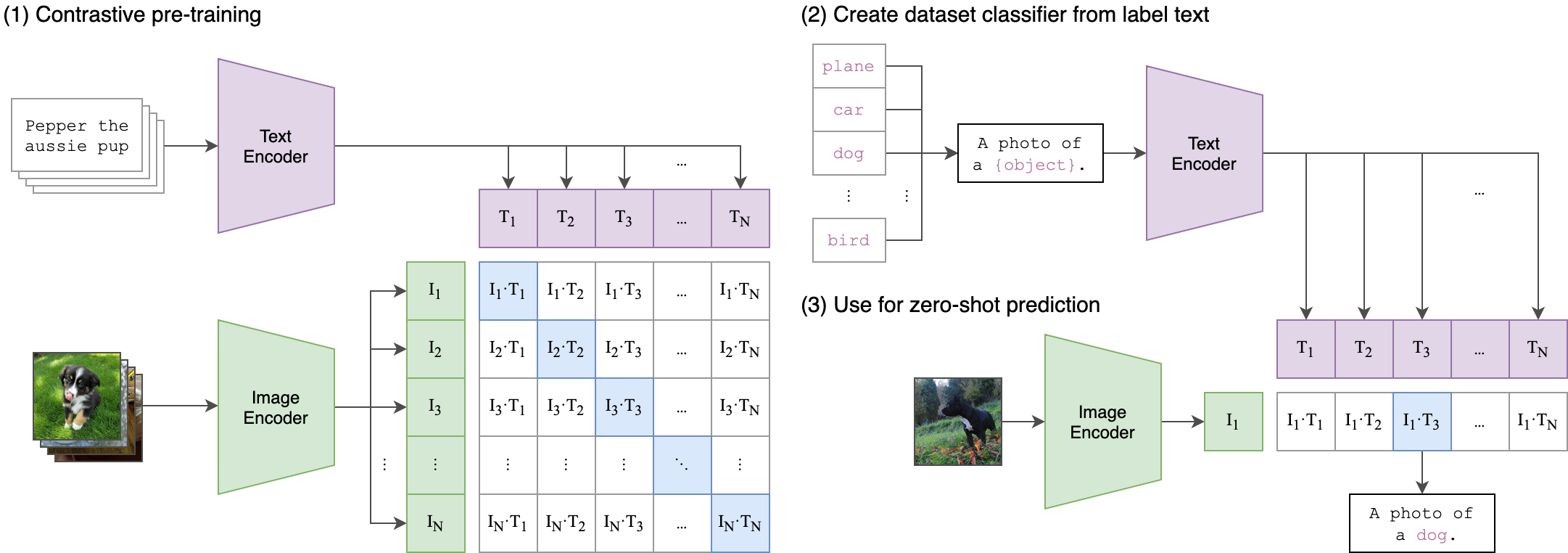
Key Features
80+ Pretrained Models
80+ Pretrained Models
OpenCLIP provides a comprehensive collection of pretrained models trained on various datasets including LAION-400M, LAION-2B, and DataComp-1B. Models range from efficient mobile architectures to large-scale transformers achieving up to 85.4% zero-shot accuracy on ImageNet.
Distributed Training Support
Distributed Training Support
Battle-tested on up to 1024 A100 GPUs with native support for SLURM clusters. Includes optimizations like gradient accumulation, local loss computation, and efficient memory management for large-scale training.
Zero-Shot Capabilities
Zero-Shot Capabilities
Perform image classification without training examples. Simply describe the classes in natural language and the model can identify them in images.
Multiple Model Architectures
Multiple Model Architectures
- Vision Transformers (ViT-B, ViT-L, ViT-H, ViT-bigG)
- ConvNet architectures (ConvNext, ResNet)
- SigLIP models for improved efficiency
- CoCa models for generative captioning
Production-Ready API
Production-Ready API
Clean, well-documented Python API with support for:
- Loading models from Hugging Face Hub
- Custom preprocessing pipelines
- Mixed precision training (FP16, BF16)
- JIT compilation
- WebDataset for large-scale datasets
State-of-the-Art Results
OpenCLIP models achieve competitive or superior performance compared to proprietary alternatives:
View the complete model zoo and zero-shot results across 38 datasets in our model documentation.
Research Foundation
OpenCLIP is backed by rigorous research on reproducible scaling laws for contrastive language-image learning:Paper: Reproducible Scaling Laws for Contrastive Language-Image Learning
Published at CVPR 2023
Published at CVPR 2023
- Training compute budget
- Dataset size and quality
- Model architecture choices
- Training hyperparameters
Use Cases
OpenCLIP powers a wide range of applications:- Zero-Shot Classification: Classify images without training data
- Image-Text Retrieval: Search images using natural language queries
- Transfer Learning: Fine-tune on downstream tasks with robust pretrained features
- Embedding Generation: Create semantic embeddings for images and text
- Content Moderation: Filter and classify visual content
- Multimodal Search: Build search engines that understand both images and text
- Data Curation: Automatically label and organize image datasets
Model Availability
All models are available through multiple channels:- PyPI package:
open_clip_torch - Hugging Face Hub: OpenCLIP library tag
- Direct download from model zoo
Community and Support
OpenCLIP is an active open-source project:- GitHub: mlfoundations/open_clip
- Issues and feature requests welcome
- Contributions from the community encouraged
Next Steps
1
Install OpenCLIP
Get started by installing the package via pip
2
Try the Quickstart
Run your first zero-shot classification example
3
Explore Models
Browse the pretrained model zoo
4
Train Your Own
Learn how to train CLIP on your own data